
1080 Baits and Dogs: What Rural Australian Owners Need to Know
1080 bait dog Australia: where baiting happens, early warning signs, what to do before you reach the vet, and how to keep your dog safe on rural properties.

Written by Bradley Brown
Founder & editor · Reviewed 2026-11-11
A quick note: this guide is general information, not veterinary advice. For anything urgent or specific to your dog, your vet is always the right call.
If you live or walk your dog in rural Australia, 1080 (sodium fluoroacetate) is a real and present danger — not a distant headline. Knowing the basics before an emergency happens is the difference between a dog that survives and one that doesn't.
Where in Australia are 1080 baits actually laid?
Sodium fluoroacetate baiting is used across most of mainland Australia to control wild dogs, dingoes, foxes, feral pigs, and rabbits. Western Australia, Queensland, New South Wales, Victoria, South Australia, and the Northern Territory all permit its use under strict regulation. Tasmania banned 1080 baiting for pest animals decades ago, so Tasmanian owners face a lower (though not zero) risk.
Baits are most commonly laid in:
- Pastoral and grazing land — particularly where wild dogs threaten livestock
- National parks and state forests with active pest-management programs
- Farmland boundaries and fence lines, including those adjoining suburban-rural interfaces on the outskirts of regional towns
- Roadsides and travelling stock routes in some states
Programs are seasonal and often intensify in late autumn and winter when wild dog activity peaks around lambing. Local councils, the NSW Department of Primary Industries, state agriculture departments, and private landholders all run separate programs, which is why baiting can occur with little public fanfare in areas you'd consider familiar and safe.
Legally, bait-laying operators must erect warning signs at entry points, but signs fade, fall over, or simply aren't seen before a dog is already off-lead. Never assume an unsigned trail is bait-free in agricultural country.
What does a 1080 bait actually look like?
Baits are designed to be attractive to target species, so they're usually made from meat (fresh or dried), manufactured meat-based pellets (Doggone™ is one common brand), or occasionally grain-based pellets for rabbit control. Meat baits are typically 30–60 mm long — a small, brownish chunk that looks like a piece of dried jerky or sausage. They can be buried just below the surface, tucked under scrub, or placed in a bait station.
You are very unlikely to identify a 1080 bait by sight alone. The poison itself is odourless and colourless; some baits are dyed to assist operators, but that dye is not visible to dogs. This is precisely why prevention, not identification, is the right strategy.
How quickly does 1080 poisoning show up, and what does it look like?
This is where 1080 is so dangerous: the onset is fast and the progression is relentless once it starts. In dogs, signs typically appear within 30 minutes to 4 hours of ingestion, though onset can occasionally be delayed up to 6 hours depending on the amount eaten and the dog's body weight.
Early signs are easy to miss or misread:
- Sudden anxiety or restlessness — the dog may seem agitated for no clear reason
- Vomiting
- Excessive salivation or drooling
- Weakness in the hindquarters or stumbling
Within minutes of these early signs, the situation escalates rapidly:
- Uncontrolled running or frenzied, directionless bolting (a distinctive and distressing symptom)
- Severe convulsions and seizures
- Loss of consciousness
- Respiratory failure
There is no antidote available in Australia for 1080 poisoning in dogs. Treatment is entirely supportive — managing seizures, maintaining breathing, and preventing further absorption — which is why the speed of your response is the single most important factor in whether your dog lives.
My dog might have eaten a bait — what do I do right now?
Move fast. Do not wait for symptoms to appear before calling a vet. If you have any suspicion — your dog picked something up on a known baiting property, you found a bait near them, or they've started vomiting after a walk in rural scrub — call your vet or the nearest emergency animal hospital immediately while you get in the car.
On the way to the vet:
- Keep the dog as calm and quiet as possible — excitement accelerates the uptake of the poison
- Do not let the dog run freely
- If the dog is already convulsing, wrap them gently in a blanket to prevent injury during transport and ensure their airway is not obstructed
- Call ahead so the clinic can prepare — tell them "possible 1080 ingestion" and your estimated arrival time
- Note the time you think ingestion occurred (or when you last saw the dog without symptoms) and report this to the vet; it helps guide treatment decisions
Do not attempt to induce vomiting yourself unless a vet specifically instructs you to and you are well within the early window — inducing vomiting during active seizures is dangerous. If a vet on the phone advises it, use 3% hydrogen peroxide solution only as directed; never use salt, which can cause sodium poisoning.
Treatment at the clinic will likely involve intravenous diazepam or barbiturates to control seizures, oxygen support, and hospitalisation. Even with aggressive treatment, prognosis can be guarded — which is why the first 30 minutes matter more than almost anything else.
How do I know if the area I'm walking in has been baited?
The honest answer is that you often won't, with certainty. But here's how to significantly reduce your risk:
| Check | How to do it |
|---|---|
| Contact local council or landcare group | Phone before walking in unfamiliar rural areas; some councils publish baiting schedules |
| Check state agriculture department websites | NSW DPI, Agriculture Victoria, DPIRD (WA), and equivalents publish program information |
| Look for baiting signs at gates and entry points | Yellow warning signs are legally required; take them seriously even if the sign looks old |
| Ask the landholder directly | If you're walking on a property with permission, ask — most landholders will tell you |
| Use the PestSmart or FeralScan apps | These platforms include some baiting activity reports from land managers |
Even in areas with no current active program, old buried baits can remain toxic for many months — particularly in cool, dry conditions where degradation slows. Moist soil and warm temperatures speed up breakdown, but you cannot count on a bait being inert just because it looks weathered.
What can I actually do to protect my dog day-to-day on rural properties?
Practical protection comes down to management, not luck.
Keep dogs on lead or under close supervision on any rural land you don't personally manage. This is the single most effective measure. A dog that is physically beside you cannot quietly investigate a bait hidden under a bush 50 metres away.
Train a reliable "leave it" cue. You don't need a perfectly obedient dog — just one that responds to this cue consistently in your yard and on familiar walks. Five minutes a day over a few weeks gets most dogs there. Use high-value treats (small pieces of cooked chicken work well) and build the behaviour somewhere boring before testing it in exciting environments. It won't guarantee safety, but it buys you critical seconds.
Talk to your neighbours. On rural properties, knowing that the paddock next door has an active baiting program is information worth having. Most landholders are willing to give you a heads-up if you ask directly and without accusation.
Consider a basket muzzle for high-risk periods. If you're in an area with known seasonal baiting — say, around lambing in grazing country — a well-fitted basket muzzle during off-lead time on your own property is a reasonable precaution. Introduce it slowly with positive reinforcement so it isn't a source of stress.
Know your nearest 24-hour emergency vet before you need one. In rural areas, that might be 90 minutes away. Programme the number into your phone now, alongside the Animal Poisons Helpline (1300 869 738), which operates 24/7 and can provide immediate guidance while you're driving.
The risk of 1080 bait to dogs in Australia is not something to be paranoid about, but it is something to be prepared for. A few minutes of planning — knowing where you're walking, keeping your dog close, and having the vet's number ready — is all it takes to shift the odds decisively in your dog's favour.
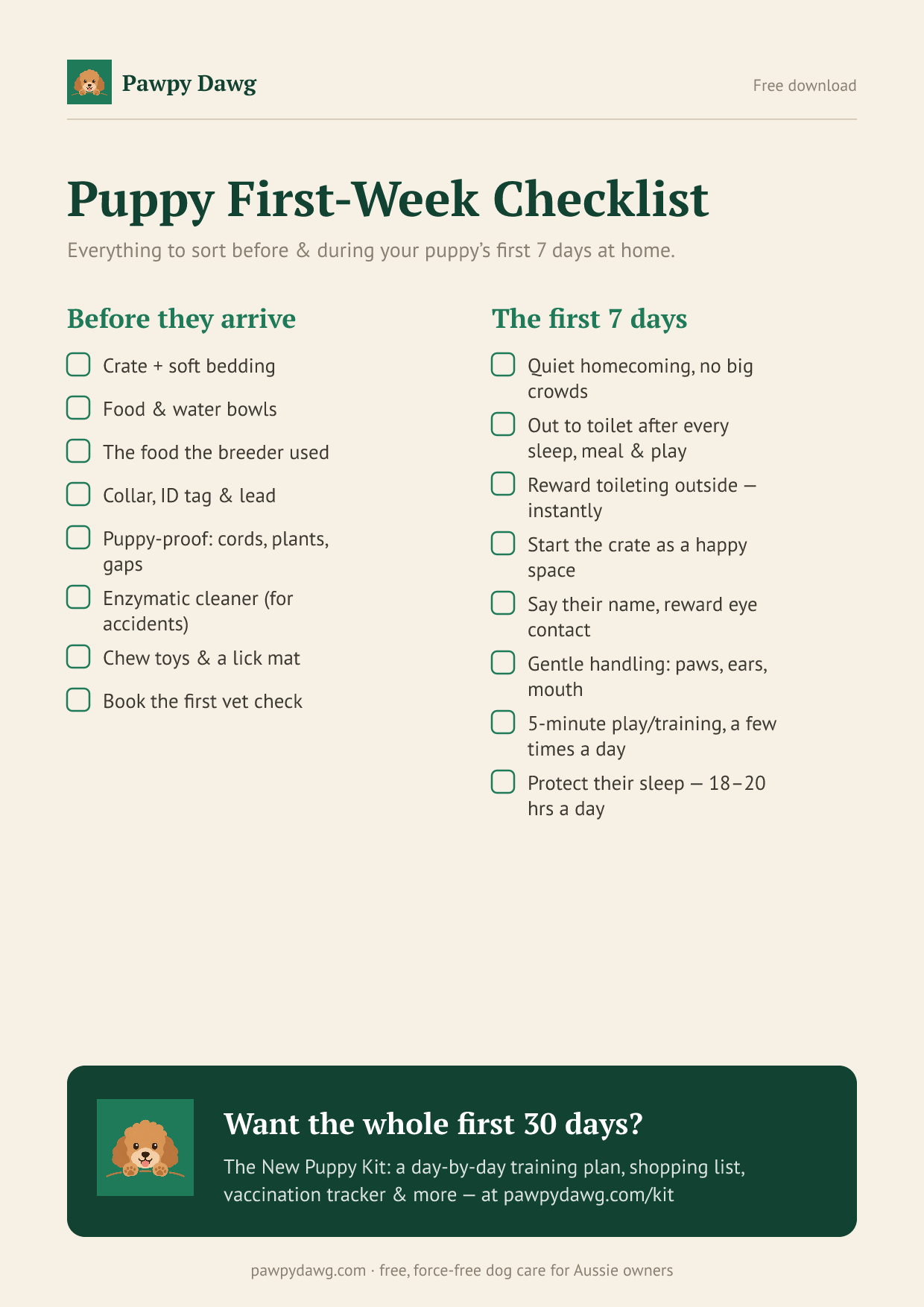
Free printable
Free: the Puppy First-Week Checklist
Everything to sort before and during your puppy's first 7 days home — a printable one-pager. Plus the occasional genuinely useful dog tip. No spam, unsubscribe anytime.
Related guides

Is Pet Insurance Worth It in Australia? The Honest Maths
Is pet insurance worth it in Australia? We crunch real premiums vs real vet bills — cruciate surgery, snake bite & more — so you can decide with confidence.
Read the guide →
How Much a Dog Really Costs Per Year in Australia (2026 Breakdown)
How much does a dog cost per year in Australia? 2026 line-item breakdown covering food, vet, insurance, grooming & the costs first-timers always miss.
Read the guide →
Dog Vaccination Schedule in Australia: What, When and What It Costs
Confused by C3, C5 and kennel cough? Here's your complete dog vaccination schedule Australia cost guide — puppy timelines, adult boosters & typical AUD prices.
Read the guide →