
Doggy Dementia: Spotting Canine Cognitive Decline Early
Learn to recognise dog dementia signs early — night pacing, confusion, house-training lapses — plus how vets diagnose CDS and what actually helps.

Written by Bradley Brown
Founder & editor · Reviewed 2026-11-12
A quick note: this guide is general information, not veterinary advice. For anything urgent or specific to your dog, your vet is always the right call.
If your older dog has started pacing the hallway at 2 am, standing in corners looking lost, or toileting inside despite years of reliable house-training, you are probably oscillating between worry and exhaustion. These behaviours are distressing to watch, easy to misread as stubbornness or spite, and — critically — easy to miss as the medical condition they often are.
Canine Cognitive Dysfunction Syndrome (CDS) is the veterinary term for what most people call dog dementia. It's a progressive neurological condition caused by physical changes in the ageing brain, and it's far more common than most owners realise. Studies suggest it affects around 14–35% of dogs over eight years old, with prevalence rising steeply past twelve. Because the early dog dementia signs overlap with normal ageing or other health problems, the condition is chronically under-reported and under-treated. That's worth fixing, because early intervention genuinely changes the trajectory.
What's Happening Inside the Ageing Brain
CDS isn't just "getting old." The brain undergoes measurable structural changes: accumulation of beta-amyloid plaques (the same protein implicated in human Alzheimer's disease), loss of dopamine-producing neurons, reduced blood flow, and oxidative damage to brain tissue. White matter shrinks. The brain's ability to clear metabolic waste — a process that happens largely during sleep — becomes less efficient.
The result is not a dog that has "forgotten its training." It's a dog experiencing genuine confusion, disrupted sleep-wake cycles, altered pain perception, and reduced capacity to process familiar environments. The hippocampus, which handles spatial memory and navigation, is among the most affected regions, which is why getting lost in a known space — like your lounge room — is such a classic symptom.
Understanding this matters because it reframes everything. When your dog stares at the wrong side of a door, that's not wilful confusion. It's a navigational system misfiring. Compassion follows understanding, and so does better management.
The DISHA Framework — What to Watch For
Veterinary behaviourists use a clinical acronym — DISHA — to categorise the five core symptom clusters. Knowing them helps you describe your dog's changes precisely when you speak to your vet.
Disorientation is often the first thing owners notice. The dog gets stuck in corners, stares blankly at walls, fails to recognise familiar people or pets, or walks to the hinge side of a door instead of the opening side. Some dogs appear briefly startled by their own reflection or by sounds they've heard thousands of times before.
Interactions change. Dogs that were once velcro-attached become indifferent, or vice versa — previously independent dogs become clingier and anxious. Some dogs stop greeting owners at the door. Others follow constantly but seem not to register who they're following.
Sleep-wake cycle disruption is frequently what brings owners to the vet after months of denial. The dog is restless, often pacing or vocalising at night, then sleeps heavily through the day. This reversal happens because melatonin production declines with age and the neurological clock governing circadian rhythms degrades. It is exhausting for owners and deeply distressing for dogs.
House-training lapses are among the most emotionally loaded symptoms. An owner who has had a reliably toilet-trained dog for ten years can feel personally failed when the dog begins urinating in the lounge. But the dog isn't regressing behaviourally — it's losing the ability to signal urgency, to remember the route outside, or to hold the connection between the urge and the action. Rule out urinary tract infections and kidney disease first (your vet will do this), but if physical causes are excluded, cognitive decline is high on the differential list.
Activity level and anxiety shifts round out the picture. Some dogs pace repetitively or perform stereotypic circling. Others become profoundly inactive and disengaged — stopping play they previously initiated, losing interest in food or walks. Vocalisation (whining, barking, howling with no obvious trigger) often emerges, particularly at night.
You don't need all five clusters to suspect CDS. Even two or three, appearing gradually over months in a dog over eight, warrants a vet conversation.
Getting a Diagnosis — What the Vet Visit Looks Like
There is no single blood test for CDS. Diagnosis is primarily clinical — it's reached by ruling out other conditions that cause similar signs, and by systematically documenting the behavioural history.
Your vet will likely run a full blood panel and urinalysis to rule out hypothyroidism, diabetes, kidney disease, liver dysfunction, and anaemia, all of which cause cognitive-looking symptoms in older dogs. Blood pressure measurement is important — hypertension causes neurological signs and is common in older dogs, particularly those with concurrent kidney or heart disease. A thorough physical and neurological examination checks for pain, hearing and vision loss, and focal neurological deficits.
If those results come back largely normal and the history fits, your vet will assess symptom severity using a validated rating tool — the most commonly used is the Canine Cognitive Dysfunction Rating Scale (CCDR), a scored questionnaire completed by owners. It quantifies the frequency and severity of DISHA symptoms and gives the vet a baseline to measure progression against.
Advanced imaging (MRI) can demonstrate brain atrophy and rule out brain tumours or vascular events, and is increasingly accessible through veterinary specialists in Australian cities. It's not always necessary, but in atypical presentations or younger dogs, it's worth the referral.
Bring notes to the appointment. A short video of the night pacing or the staring episodes is genuinely useful — it removes ambiguity and can halve the diagnostic conversation.
What Actually Helps — The Evidence-Backed Toolkit
CDS cannot be reversed. But its progression can be slowed, and quality of life can be meaningfully maintained. The intervention landscape spans diet, enrichment, environmental management, and medication.
Diet and nutritional supplements
Oxidative stress — cellular damage from free radicals — is a key driver of neurodegeneration in the ageing dog brain. Several dietary strategies target this directly.
Diets high in antioxidants (vitamins C and E, selenium, beta-carotene), omega-3 fatty acids (specifically DHA and EPA), and medium-chain triglycerides (MCTs) have demonstrated cognitive benefits in clinical trials. Hill's Prescription Diet b/d (Brain Aging Care) is the most studied commercially available option; a randomised controlled trial showed improved learning and memory in older dogs after 60 days. Royal Canin's Senior Consult range and Purina Pro Plan Bright Mind are other commercially available options with relevant formulation.
MCT oil (coconut oil is a source, though not a pure MCT supplement) provides an alternative fuel source for neurons that have become less efficient at metabolising glucose — a phenomenon documented in both canine and human cognitive decline. Discuss dosing with your vet before adding it; gastrointestinal upset is the most common side effect of too much too soon.
SAMe (S-adenosylmethionine) is a supplement with reasonable evidence for cognitive support in dogs; Denosyl is a commonly available veterinary brand in Australia. Phosphatidylserine and ginkgo biloba appear in various senior cognitive supplements with some supporting data, though the evidence is less robust. Your vet can help you sort the signal from the noise here.
Enrichment that doesn't exhaust you
The goal of mental enrichment in a CDS dog isn't to challenge them the way you'd challenge a young Border Collie. It's to provide gentle, predictable novelty that keeps neural pathways active without triggering overwhelm or frustration.
Five to ten minutes of sniff-based activity per day — scatter feeding on grass, a simple snuffle mat, or a licki mat with something smelly — engages the olfactory system, which tends to remain relatively intact even as other faculties decline. Short, calm sniff walks (let the dog lead the nose) are more cognitively valuable than a brisk structured walk.
Simple, familiar games — nosework hiding a treat under one of two cups — can maintain problem-solving engagement without demanding complex learning. Avoid introducing entirely new activities; stick to things the dog already knows and enjoys.
Predictable daily routines have a measurable calming effect in CDS dogs. Feeding, toileting, walks, and sleep at consistent times reduces anxiety because the dog can anticipate transitions rather than be startled by them.
Environmental adjustments that make a real difference
Block off areas where the dog gets stuck or confused — particularly rooms with dead ends or complex furniture configurations. Night lights genuinely help disoriented dogs navigate at night; this is a cheap, easy win. Baby gates used to simplify the dog's usable space (rather than to restrict them punitively) reduce the number of navigational decisions they need to make.
For house-training lapses, increase toilet opportunities — take the dog out more frequently, especially last thing at night and immediately on waking. Use washable waterproof mats or dog nappies at night if the stress of overnight accidents is affecting you both. Manage the environment, not the dog's behaviour.
Medication
Selegiline (brand name Anipryl, also known as L-deprenyl) is the only drug specifically registered for the treatment of CDS in several countries, including Australia. It works by inhibiting monoamine oxidase B, increasing dopamine availability in the brain and reducing free radical production. It is not a cure, and response is variable — studies suggest roughly 30–50% of dogs show meaningful improvement in clinical signs, with best results when started early. It takes four to eight weeks to assess response.
Melatonin supplementation addresses the sleep-wake disruption directly and is worth discussing with your vet, particularly if night restlessness is the dominant complaint. Dosing in dogs is not standardised; get a specific recommendation for your dog's weight.
Anxiolytic medication — short-term or situational — can be warranted if anxiety or night vocalisation is severe enough to compromise the dog's welfare or the owner's ability to continue care. This is a conversation for your vet rather than something to manage with over-the-counter human products.
The Prognosis — Honest, Not Bleak
CDS is progressive. The rate of progression varies considerably between individuals, and dogs with mild-to-moderate symptoms managed with diet, enrichment, and appropriate medication can remain comfortable and connected for months to years after diagnosis.
The hardest part for most owners is recalibrating expectations — a CDS dog may no longer want the activities they once loved, may sleep most of the day, may be confused by things that feel basic. That's not failure. That's the condition. What matters is that the dog is not in distress, is physically comfortable, and still has moments of engagement and pleasure. Your vet can help you identify what a good quality of life looks like at each stage, and when that threshold is no longer being met.
If you've been watching your older dog change and wondering whether you're imagining it — you're probably not. Bring the notes, bring the video, and have the conversation. Earlier is always better.
As an Amazon Associate we earn from qualifying purchases.
Frequently asked questions
At what age do dogs typically start showing signs of dementia?
CDS can appear in dogs as young as eight, but it becomes significantly more common after eleven or twelve. Small breeds tend to live longer and may show signs later in life, while large and giant breeds can develop cognitive changes earlier. If your dog is over eight and showing behavioural changes, it's worth raising with your vet regardless of breed.
My dog is pacing at night — could it be something other than dementia?
Yes, and your vet will want to rule these out first. Pain (particularly arthritis), hypertension, hyperthyroidism, neurological conditions, and anxiety disorders can all cause night restlessness. A blood panel, urinalysis, and blood pressure check are standard first steps before attributing night pacing to cognitive decline.
Is there a test my vet can do to confirm dog dementia?
There's no single definitive test. Diagnosis is reached by ruling out other medical causes through bloodwork and physical examination, then assessing behavioural history using a validated scoring tool like the CCDR scale. MRI can show brain atrophy and rule out tumours, and is available through veterinary specialists in most Australian capital cities.
Can diet actually slow down canine cognitive dysfunction?
The evidence is reasonably strong that antioxidant-rich diets, omega-3 fatty acids (DHA/EPA), and medium-chain triglycerides can slow neurodegeneration and support brain function in ageing dogs. Hill's b/d has the most clinical trial data behind it. Supplements like SAMe (Denosyl) also have supporting evidence. These won't reverse existing damage, but started early enough they can meaningfully slow progression.
My dog has started toileting inside — is it too late to do anything?
It's not too late, and house-training lapses in a CDS dog aren't a training failure — they reflect a loss of signalling ability and spatial memory. The practical response is more frequent toilet trips (especially before bed and immediately on waking), night lights to help navigation, and waterproof mats or dog nappies overnight. Managing the environment rather than correcting the behaviour is the right approach.
How much does treatment for dog dementia cost in Australia?
Initial diagnostic workup — bloodwork, urinalysis, physical exam — typically runs $200–$450 AUD depending on the clinic and what tests are needed. Selegiline (Anipryl) costs roughly $80–$150 AUD per month depending on dose. Prescription diets like Hill's b/d run around $100–$130 AUD for an 11 kg bag. MRI referral, if needed, can range from $1,500–$3,000 AUD. Pet insurance with illness cover can offset these costs significantly.
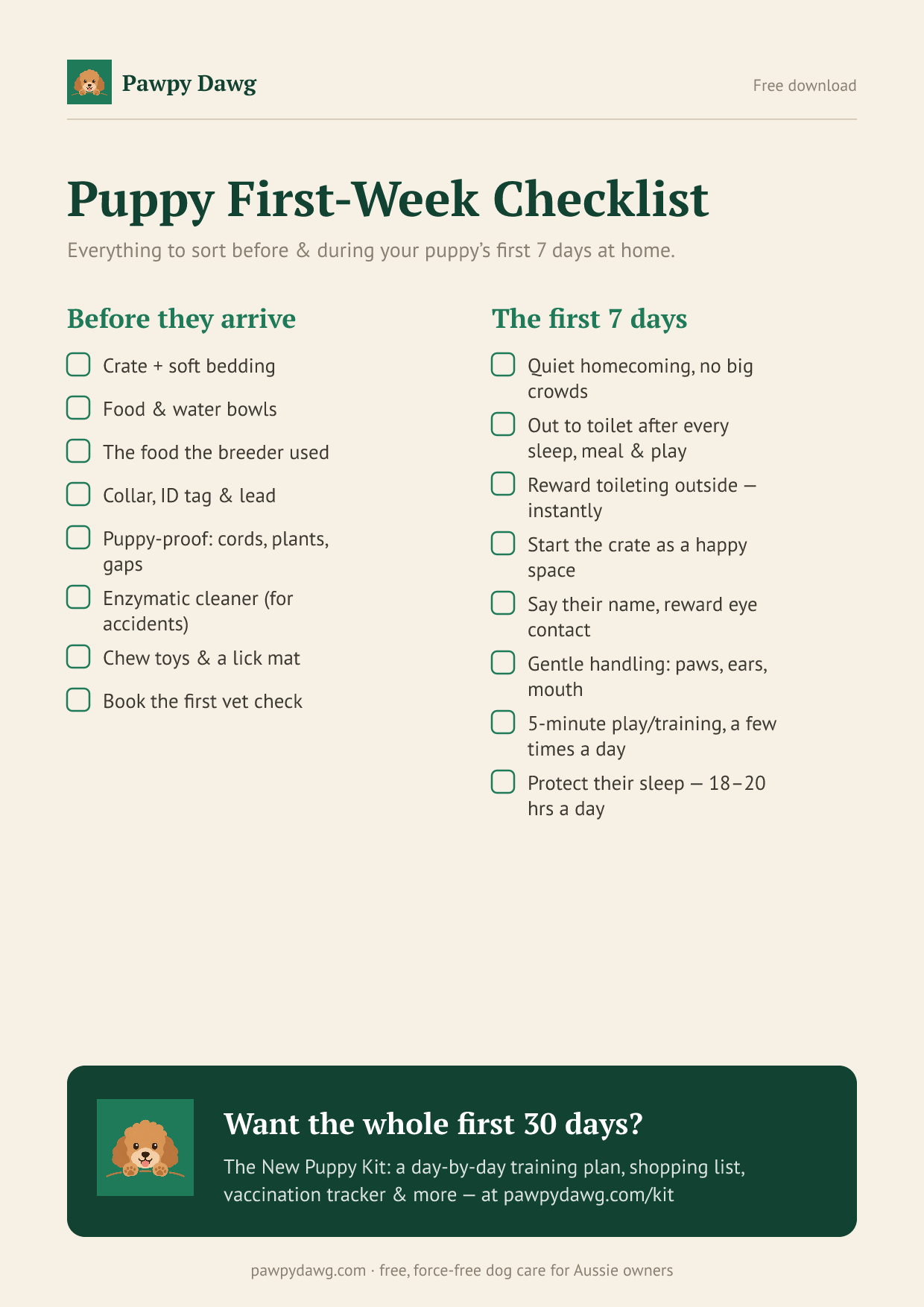
Free printable
Free: the Puppy First-Week Checklist
Everything to sort before and during your puppy's first 7 days home — a printable one-pager. Plus the occasional genuinely useful dog tip. No spam, unsubscribe anytime.
Related guides

Is Pet Insurance Worth It in Australia? The Honest Maths
Is pet insurance worth it in Australia? We crunch real premiums vs real vet bills — cruciate surgery, snake bite & more — so you can decide with confidence.
Read the guide →
How Much a Dog Really Costs Per Year in Australia (2026 Breakdown)
How much does a dog cost per year in Australia? 2026 line-item breakdown covering food, vet, insurance, grooming & the costs first-timers always miss.
Read the guide →
Dog Vaccination Schedule in Australia: What, When and What It Costs
Confused by C3, C5 and kennel cough? Here's your complete dog vaccination schedule Australia cost guide — puppy timelines, adult boosters & typical AUD prices.
Read the guide →