
Grass Seeds and Dogs: The Summer Vet Visit You Can Avoid
Grass seeds dog Australia: spot the warning signs, do a 5-min daily check, and avoid a costly vet visit this summer. Practical tips for paws, ears & eyes.

Written by Bradley Brown
Founder & editor · Reviewed 2026-11-06
A quick note: this guide is general information, not veterinary advice. For anything urgent or specific to your dog, your vet is always the right call.
If you've come home from a walk to find your dog shaking their head, chewing at a paw, or squinting one eye, you're not imagining things — and you haven't done anything wrong. Grass seeds are one of the most common and genuinely nasty hazards of the Australian summer, and they catch out even the most attentive owners. The good news is that a quick daily habit can save you a stressful vet trip and a bill that often runs into the hundreds.
The quick win you can use right now
Before you read another word, go get your dog and run your fingers slowly through the fur between their toes. Feel for anything small, hard, or pointy — a grass seed looks like a tiny pale arrow and feels like a splinter. If you find one that hasn't yet broken the skin, flick it away with your fingers or a fine-toothed comb. Done. That five seconds may have just saved your dog a week of limping.
Why grass seeds are so dangerous
Grass seeds — particularly from barley grass, wild oats, and spear grass — are engineered by nature to travel in one direction only. The barbed tip burrows forward with every muscle movement, which means a seed that lands on your dog's coat doesn't stay there. It works its way through fur, pierces skin, and migrates into tissue. Left long enough, seeds have been found in lungs, spinal canals, and abdominal cavities — none of which end cheaply or quickly.
The three places seeds love most are:
- Between the toes and paw pads — warm, moist, and hidden by fur
- Inside the ear canal — seeds drop in when dogs sniff low through long grass
- Around the eyes — particularly in dogs with longer facial fur
Signs your dog has a seed problem
Catching the signs early is everything. Here's what to watch for:
- Paws: Persistent licking or chewing at one specific spot, swelling between the toes, a small red hole or discharge. Dogs will often target just one paw, which distinguishes a seed from general itchiness.
- Ears: Sudden, violent head-shaking — especially if it starts immediately after a walk. Pawing at one ear, tilting the head to one side, or whimpering when you touch the ear flap.
- Eyes: Squinting, tearing, pawing at one eye, or visible redness. A seed behind the third eyelid is surprisingly common and extremely uncomfortable.
If you're seeing any of these after a grassy walk, treat it as urgent. Seeds move fast.
Your 5-minute post-walk check routine
This takes less time than filling the water bowl, and it becomes second nature within a week.
- Paws first. Spread each foot gently and check every gap between the toes. Run a finger along each pad. Look for any matted fur that could be hiding a seed.
- Ears next. Lift each ear flap and look at the entrance to the canal with a torch. Smell counts — a sudden yeasty or musty odour can signal a seed is already causing irritation.
- Face and eyes. Look for any tearing, squinting, or debris caught in the fur near the eye corners.
- Body sweep. Run both hands against the direction of coat growth across the chest, armpits, and groin — areas where seeds collect as dogs push through long grass.
- Comb the coat. A quick pass with a slicker brush or fine metal comb catches seeds before they reach skin, particularly on dogs with longer or wavier coats.
The whole thing takes five minutes while your dog is still calm from the walk.
Clipping tips that make seeds less likely to stick
You don't need to shave your dog — a targeted tidy-up does the job. Focus on:
- Paw fur: Trim the hair between the toes flush with the pads using blunt-nosed scissors or a small clipper. This is the single highest-impact clip you can do.
- Ear openings: For floppy-eared breeds, keep the fur around the ear canal entrance short. Ask your groomer to leave the inside of the flap tidy.
- Underbelly and groin: A light trim here stops seeds collecting as your dog trots through grass.
Do this every four to six weeks through spring and summer, or ask your groomer to include a "seed clip" — most understand exactly what you mean.
What removal actually costs
If a seed is still visible and hasn't penetrated skin, removal at home or at the vet is straightforward. Once it's burrowed in, the costs scale quickly. A general consultation to investigate a sore paw typically starts around $80–$120 AUD. If the seed has migrated and requires sedation, flushing, or surgical exploration, you're looking at $300–$800 AUD or more, depending on depth and location. Ear seeds that have caused infection often need a course of ear drops on top of the removal fee.
Pet insurance with a low excess can soften the blow, but the simplest saving is the daily check. Grass seeds dog Australia searches spike every spring for a reason — this is an extremely common problem with an extremely simple preventive habit. Stick to the five-minute routine, keep the fur trimmed, and the odds are firmly in your favour.
Frequently asked questions
How do I know if my dog has a grass seed in their paw?
The most telling sign is your dog obsessively licking or chewing at one specific spot on a single paw — not general paw-licking across all feet. You may also see swelling between the toes, a small red puncture hole, or discharge. Catching it at the licking stage, before the skin breaks, makes removal much simpler.
Can a grass seed in a dog's ear go away on its own?
No. Unlike other foreign bodies, grass seeds only move forward due to their barbed structure. A seed in the ear canal will not work its way out — it will keep migrating deeper, causing increasing pain and infection. This one needs a vet as soon as you notice the signs.
What types of grass are most dangerous for dogs in Australia?
Barley grass, spear grass, and wild oats are among the most common culprits across Australia. They produce seeds with sharp, backward-facing barbs that penetrate fur and skin easily. These grasses are widespread on roadsides, parks, and paddock edges and are most hazardous from late spring through summer when they dry out and shed.
How much does it cost to remove a grass seed from a dog in Australia?
A straightforward surface removal during a standard vet consultation typically costs $80–$120 AUD. If the seed has migrated under the skin or into the ear canal and requires sedation or flushing, fees commonly range from $300 to $800 AUD or more. Early detection dramatically reduces the cost.
Which dog breeds are most at risk from grass seeds?
Dogs with long, wavy, or thick coats — such as Spaniels, Golden Retrievers, Border Collies, and Doodle crosses — are at higher risk because seeds can tangle in their fur before reaching skin. Long-eared breeds are especially prone to ear seeds. That said, short-coated dogs are not immune, particularly between the toes.
Can I remove a grass seed from my dog's paw at home?
If the seed is clearly visible on the surface and hasn't broken the skin, you can carefully remove it with tweezers or your fingers and clean the area with mild antiseptic. If the skin looks broken, there's swelling, discharge, or your dog is in obvious pain, see a vet — attempting to dig for a buried seed at home risks pushing it deeper or introducing infection.
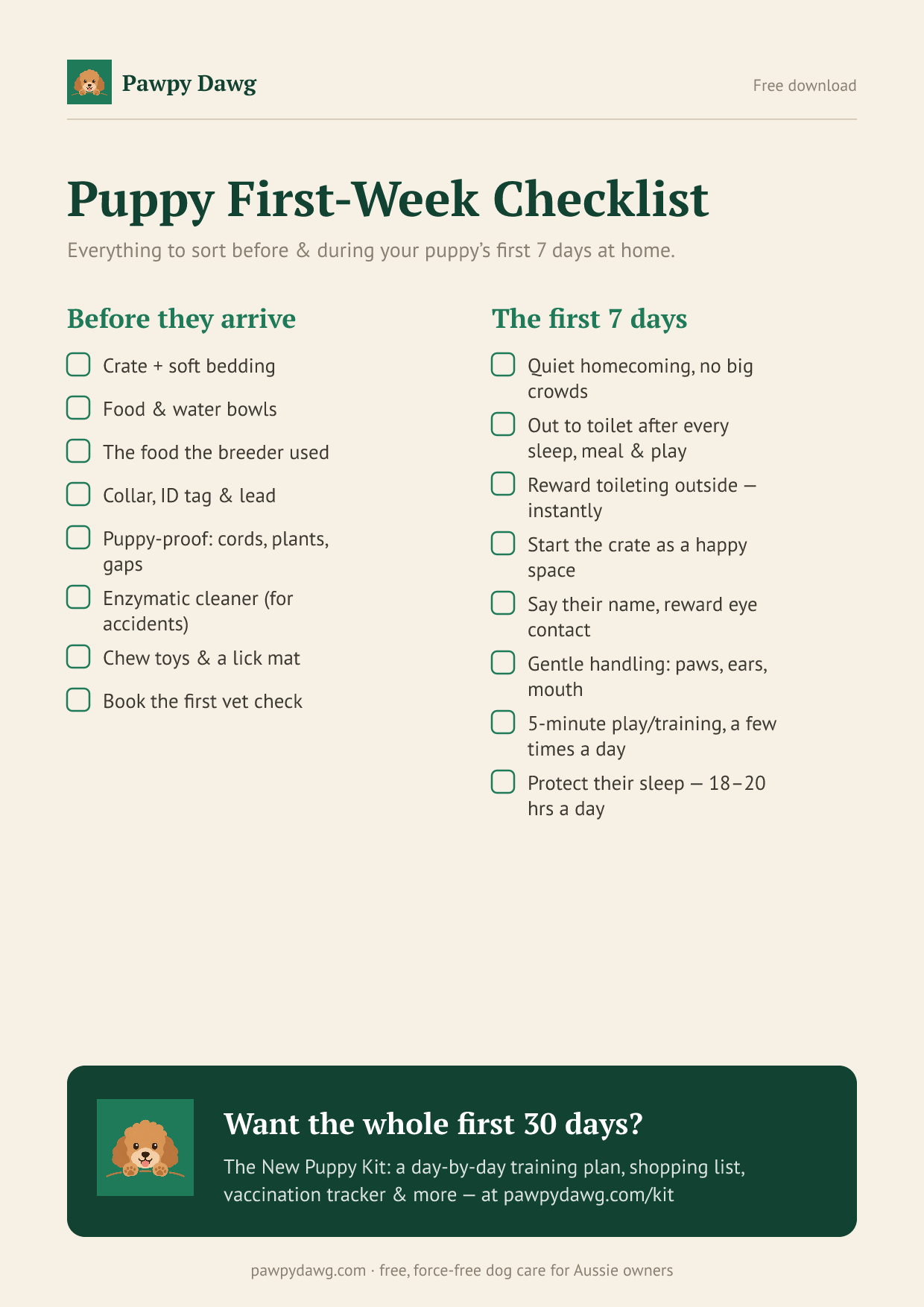
Free printable
Free: the Puppy First-Week Checklist
Everything to sort before and during your puppy's first 7 days home — a printable one-pager. Plus the occasional genuinely useful dog tip. No spam, unsubscribe anytime.
Related guides

Is Pet Insurance Worth It in Australia? The Honest Maths
Is pet insurance worth it in Australia? We crunch real premiums vs real vet bills — cruciate surgery, snake bite & more — so you can decide with confidence.
Read the guide →
How Much a Dog Really Costs Per Year in Australia (2026 Breakdown)
How much does a dog cost per year in Australia? 2026 line-item breakdown covering food, vet, insurance, grooming & the costs first-timers always miss.
Read the guide →
Dog Vaccination Schedule in Australia: What, When and What It Costs
Confused by C3, C5 and kennel cough? Here's your complete dog vaccination schedule Australia cost guide — puppy timelines, adult boosters & typical AUD prices.
Read the guide →