
Parvovirus in Puppies: Warning Signs and Prevention in Australia
Parvovirus puppy Australia: spot the early warning signs, understand the vaccination schedule, and know what treatment really costs before it's too late.
Written by Bradley Brown
Founder & editor · Reviewed 2026-11-11
A quick note: this guide is general information, not veterinary advice. For anything urgent or specific to your dog, your vet is always the right call.
Canine parvovirus kills puppies fast — sometimes within 48 hours of the first symptom — and it's still circulating widely across Australia. Here's what every owner needs to know, from the first red flag to disinfecting after an outbreak.
What actually makes parvo so deadly for young pups?
Parvovirus attacks two things at once: the lining of the small intestine and the bone marrow. The intestinal damage means your puppy can't absorb water or nutrients, so it dehydrates catastrophically even while drinking. The bone marrow suppression drops white blood cell counts, stripping away the immune response right when the body needs it most.
Puppies aged six weeks to six months are the highest-risk group because their immune systems are still maturing and maternal antibodies — the protection passed through mum's milk — fade before the puppy's own vaccinations have fully kicked in. That window, roughly weeks 6–16, is when parvo hits hardest. Adult dogs can contract it too, but they're far more likely to survive without intensive care.
The virus itself is extraordinary in how long it persists. Outdoors in Australian conditions it can survive in soil for months, sometimes over a year in cool, shaded ground. It shrugs off most household disinfectants. A single infected dog shedding virus in a park, footpath, or pet shop can contaminate a space that remains dangerous long after that dog is gone — which is why puppies can catch it without ever meeting another dog.
What are the early warning signs owners miss?
The problem with parvo is that the first signs look like a mild tummy upset. By the time the classic presentation appears, the puppy is already seriously ill.
Watch for this sequence:
| Stage | What you see | Rough timing |
|---|---|---|
| Early | Lethargy, reduced appetite, low-grade fever | Hours 0–24 |
| Developing | Vomiting (may be frothy or yellow), depression | Hours 12–48 |
| Severe | Profuse bloody diarrhoea, collapse, severe dehydration | Hours 36–72 |
The bloody diarrhoea has a distinctive, foul odour that experienced vets and breeders describe as unmistakable — but don't wait for blood to appear before acting. A puppy under six months that becomes suddenly lethargic and vomits even once warrants a same-day vet call. With parvo, waiting overnight to see if they "bounce back" costs critical hours.
Dehydration signs to check right now: gently lift the skin at the scruff — it should snap back immediately. If it stays tented for even a second, that's already moderate dehydration. Pale, grey, or tacky gums are an emergency.
Does the vaccination schedule actually matter that much?
Yes — and the timing is more precise than most owners realise.
The standard Australian vaccination protocol for puppies involves a course of C3 vaccines (covering distemper, hepatitis, and parvovirus) given at roughly 6–8 weeks, 10–12 weeks, and 14–16 weeks. The reason for multiple doses isn't that one dose is weak — it's that maternal antibodies still circulating in the puppy's blood can neutralise the vaccine, so vets can't know exactly when those antibodies have faded enough for the puppy to mount its own response. Giving three doses across that window catches the puppy at the right moment.
This matters enormously in practice. A puppy that received only its first shot at 8 weeks and then missed the follow-up at 12 weeks is not adequately protected, even though it has had a vaccination. Parvo protection is considered reliable only after the final puppy dose, usually at 16 weeks, with a booster at 12–16 months.
The practical implication: until that full course is complete, your puppy shouldn't be on ground where unknown dogs have been — no dog parks, no pet shop floors, no sniffing along footpaths in high-traffic areas. Puppy socialisation classes run by reputable trainers on regularly disinfected surfaces indoors are generally considered lower risk and worth the benefit, but check the venue's protocol before you go.
Cost of the full puppy vaccine course in Australia typically runs $150–$300 depending on your state and clinic, often bundled into a puppy health package. That's a fraction of treatment costs if parvo takes hold.
If my puppy gets parvo, what does treatment look like?
There's no antiviral drug that kills parvovirus. Treatment is entirely supportive — keeping the puppy alive while its immune system fights the virus — and it's intensive.
Standard treatment involves hospitalisation with intravenous fluids to replace what's being lost through vomiting and diarrhoea, anti-nausea medication, antibiotics to prevent secondary bacterial infection (the damaged gut lining lets gut bacteria leak into the bloodstream), and careful nutritional support. Puppies are monitored around the clock.
Survival rates with prompt, full veterinary care run roughly 70–90%. Without treatment, survival drops to below 20% — and many of those survivors have long-term health consequences. The difference almost entirely comes down to how quickly IV fluids are started.
The honest cost conversation: Treatment for parvo in Australia typically costs $2,000–$8,000 depending on how sick the puppy is, how long hospitalisation lasts, and the clinic. A puppy that crashes on a Friday night at an emergency hospital in a capital city will cost more than a puppy caught early at a suburban vet on a Tuesday morning. Some puppies need five to seven days of intensive care. Pet insurance that includes illness cover — taken out before symptoms appear — can be the difference between affording treatment and facing an impossible decision.
If cost is a barrier, have an honest conversation with your vet immediately. Some clinics offer payment plans, and there are charities that assist in genuine hardship cases. A vet who knows you're trying will often work with you on a modified protocol rather than no treatment at all.
How contagious is it, and how do I clean up properly?
Parvovirus spreads through faeces — directly from an infected dog or indirectly via contaminated shoes, clothing, hands, bowls, leads, and bedding. You can carry it in on the soles of your shoes without knowing. It doesn't spread through the air.
Shedding begins before symptoms appear and continues for up to three weeks after recovery, which means an apparently healthy dog returning from wherever it picked up the virus can silently contaminate your home and yard.
Standard household disinfectants — including most "antibacterial" sprays and even bleach at low concentrations — do not reliably kill parvovirus. What does work:
- Diluted bleach (sodium hypochlorite): 1 part bleach to 30 parts water on hard, non-porous surfaces. Contact time of at least 10 minutes matters.
- Accelerated hydrogen peroxide products (such as Rescue or F10): effective and less corrosive on fabrics and surfaces.
- Steam cleaning at temperatures above 100°C on surfaces that tolerate it.
Soft furnishings, carpets, and soil are the problem. Carpet that has been contaminated is extremely difficult to fully decontaminate — professional steam cleaning plus an appropriate virucidal product gives the best chance, but replacement is sometimes the only certain answer. Contaminated soil in a yard should be quarantined for unvaccinated dogs for at least six months; planting densely or laying new paving over affected patches reduces but doesn't eliminate risk.
Wash your hands and change shoes before handling an unvaccinated puppy if you've been anywhere dogs congregate. It sounds excessive until it isn't.
My puppy's breeder said it already had a shot — is that enough?
Probably not, and this is one of the most common sources of confusion.
A single vaccination at four or six weeks, sometimes given by breeders before sale, provides limited and short-lived protection. It may also have been interfered with by maternal antibodies and had no effect at all. Reputable breeders do this with good intentions — it's better than nothing — but it does not replace the full three-dose puppy course given by a vet.
When you pick up a new puppy, ask for the vaccination certificate and take it to your vet at the first health check (ideally within 48–72 hours of bringing the puppy home). Your vet will tell you exactly where the puppy sits in the schedule and when the next dose is due. If there's any uncertainty about what was given or when, the safe choice is to restart the schedule — the risk of an unnecessary booster is essentially zero; the risk of a gap in protection is not.
Australian conditions — the climate, the density of dogs in urban areas, and the resilience of the virus in our soil — make parvovirus puppy Australia vets see a genuinely common emergency, not a theoretical risk. The good news is that it's almost entirely preventable with a completed vaccination course and a few sensible precautions during those first vulnerable months.
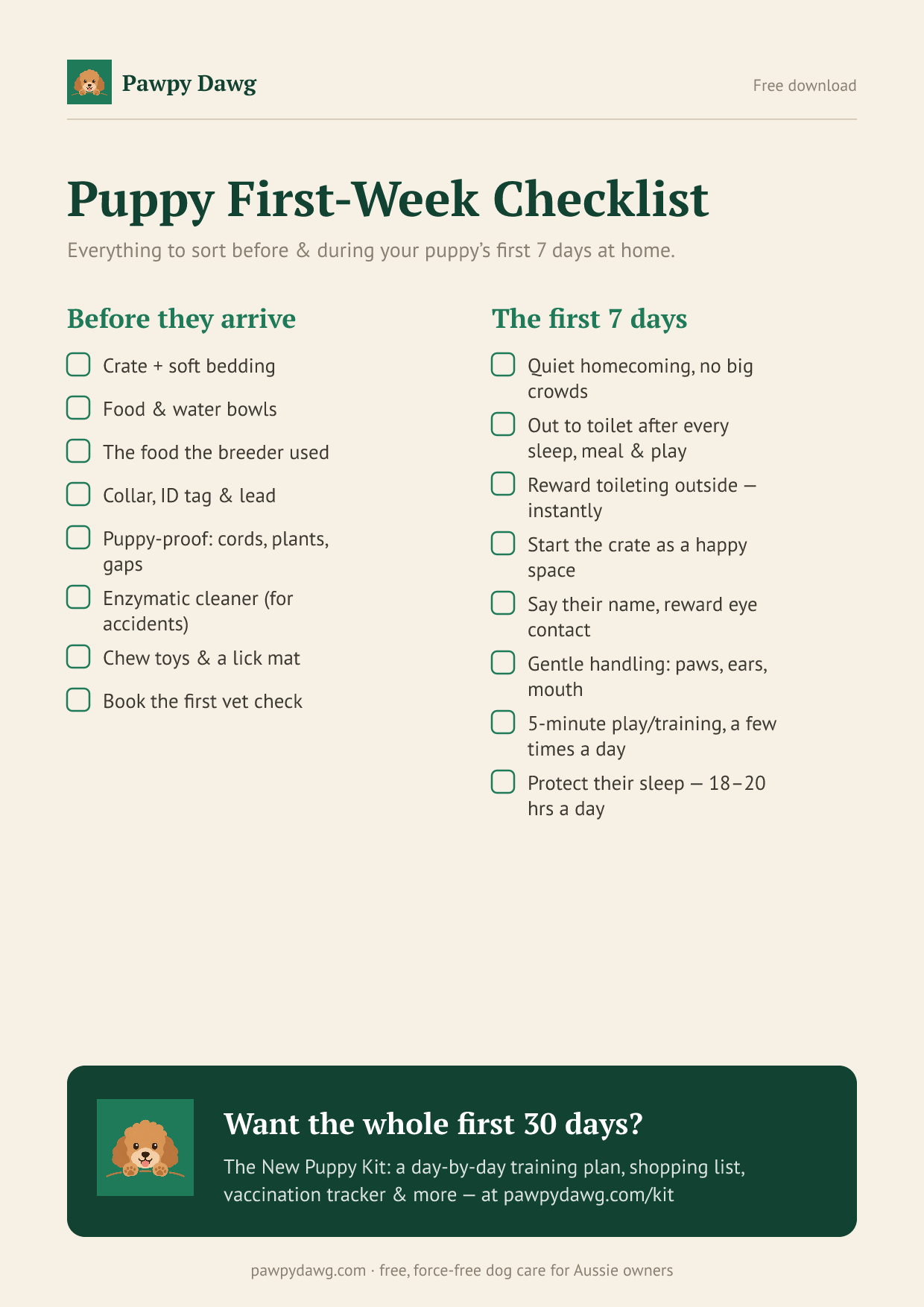
Free printable
Free: the Puppy First-Week Checklist
Everything to sort before and during your puppy's first 7 days home — a printable one-pager. Plus the occasional genuinely useful dog tip. No spam, unsubscribe anytime.
Related guides

Is Pet Insurance Worth It in Australia? The Honest Maths
Is pet insurance worth it in Australia? We crunch real premiums vs real vet bills — cruciate surgery, snake bite & more — so you can decide with confidence.
Read the guide →
How Much a Dog Really Costs Per Year in Australia (2026 Breakdown)
How much does a dog cost per year in Australia? 2026 line-item breakdown covering food, vet, insurance, grooming & the costs first-timers always miss.
Read the guide →
Dog Vaccination Schedule in Australia: What, When and What It Costs
Confused by C3, C5 and kennel cough? Here's your complete dog vaccination schedule Australia cost guide — puppy timelines, adult boosters & typical AUD prices.
Read the guide →