
Taking Your Dog to the Beach in Australia: Rules, Safety and Gear
Dog friendly beaches Australia rules vary by council — here's how to check access, keep your dog safe from heat, rips and salt water, and what to pack.

Written by Bradley Brown
Founder & editor · Reviewed 2026-11-13

Australia has some of the most spectacular coastline on earth, and plenty of it is genuinely welcoming to dogs — but "plenty" does not mean "all of it, all the time." The rules are fragmented by state, council, and sometimes by individual beach, and they change seasonally. Getting this wrong means a fine or, worse, a confrontation with rangers that ruins the day. Getting it right means your dog gets one of the best experiences a dog can have.
Finding the Actual Rules for Your Beach
Dog friendly beaches Australia rules are not held in one place. There is no national database, no single app, and no council that uses identical signage to another. That is the starting reality.
The most reliable method is to go directly to your local council's website and search "dogs on beaches." Most Australian councils publish a beach-access map or a PDF listing permitted beaches, times, and leash conditions. Sydney councils, for example, typically restrict dogs to specific beaches (like Sirius Cove or Turrumburra) with seasonal off-leash windows — often before 9 am and after 4 pm in summer. Melbourne's Port Phillip Bay has a patchwork of on-leash, off-leash, and prohibited zones that differ block by block. Queensland councils are arguably the most restrictive; Gold Coast City Council bans dogs from most patrolled beaches entirely.
Seasonal restrictions matter more than people expect. Many beaches that allow dogs year-round impose bans from October through April during peak swimming season, or from September through March to protect nesting shorebirds like hooded plovers and little terns. These are not arbitrary — they carry real fines, commonly $300–$500, and rangers do patrol popular beaches in summer.
Before you go, check:
- Your local council's website (search "[suburb name] council dogs on beach")
- The Dogs on Beaches section of your state's Department of Environment or Parks authority for national park adjacent beaches
- A quick call to the council ranger line if the information online is ambiguous — they will tell you, and you have a record of the advice
Do not rely on what other dog owners tell you in the car park. Rules change, and other owners can be wrong with complete confidence.
Why Heat and Sand Are a More Serious Threat Than Most People Realise
A beach trip in summer feels carefree, but the thermal environment at the coast is genuinely hostile to dogs in ways that differ from a backyard. Sand surface temperatures are the most underestimated hazard. Air temperature of 28°C on a clear day can produce sand temperatures exceeding 60°C — hot enough to cause full-thickness burns to paw pads within 60 seconds of contact. The "seven-second test" is legitimate: press the back of your hand firmly to the sand for seven seconds. If you pull away, it's too hot for your dog's paws.
Dogs also cannot sweat through their skin the way humans do. They lose heat almost entirely through panting and, to a minor degree, through their paw pads. At the beach, they are surrounded by reflective water and white sand that amplifies UV and radiant heat from multiple angles simultaneously. Heatstroke in dogs begins at a core temperature of around 40°C (normal is 38–39°C) and becomes life-threatening rapidly above 41.5°C. Brachycephalic breeds — bulldogs, pugs, French bulldogs — are at risk at temperatures that feel comfortable to everyone else because their restricted airways make panting less effective.
Practical mitigation, not just vague advice:
- Arrive before 9 am or after 5 pm in summer; midday beach visits are genuinely dangerous for dogs
- Bring more fresh water than you think you need — a medium dog needs at least 500 ml per hour of activity in heat
- Use shade tents or beach shelters; dogs left on open sand in the sun while you swim will overheat faster than you expect
- Wet your dog's chest, belly, groin, and armpits (not just the back) — these are the areas with the best blood flow for cooling
- Know the signs of heatstroke: excessive panting that doesn't slow, drooling thick saliva, gums turning pale or bright red, stumbling. This is an emergency requiring cold wet towels and immediate veterinary attention — not a "wait and see"
Surf, Rips, and Whether Your Dog Can Actually Swim
A widespread assumption is that dogs are natural swimmers. Many are competent, but enthusiasm and ability are not the same thing. Labrador retrievers and Portuguese water dogs were selectively bred for water work; a barrel-chested bulldog or a low-slung basset hound may keep themselves afloat but tires within minutes. Even strong swimming breeds can be caught out by surf conditions that would trouble a human swimmer.
Rip currents are the specific danger. Rips run perpendicular to the beach — often visibly darker, choppier, or foamy — and can move at 2 metres per second. A dog caught in a rip will instinctively swim directly against it, exhausting itself quickly. Unlike a human who can be instructed to swim parallel to shore, your dog has no framework for that strategy. It will keep swimming toward you, against the current, until it can't.
If your dog swims in surf, stay in the water with them and keep them close to you. Avoid the gutters alongside sandbars where rips typically form. Calm, patrolled beaches with gentle shore breaks are genuinely safer than dramatic surf beaches for dogs, regardless of how much your dog wants to charge into the waves. A well-fitted dog life jacket is not an affectation for strong-swimming dogs at surf beaches — it provides buoyancy during exhaustion and a handle for retrieval.
Watch for signs of water exhaustion: paddling that becomes frantic rather than rhythmic, the head dropping lower in the water, whimpering. Get them out before they reach that point.
Salt Water Ingestion and Sand — Two Problems That Ruin the Drive Home
Dogs at the beach drink salt water and eat sand. These are almost universal behaviours, and both cause real problems.
Salt water causes osmotic diarrhoea because the salt draws water from the intestinal lining into the gut. Even moderate ingestion — say, repeatedly lapping at rock pools — can produce profuse watery diarrhoea within one to two hours, leaving your dog dehydrated and miserable on the way home. The solution is consistent access to fresh water throughout the day so your dog is never thirsty enough to turn to the sea. Bring a non-spill travel bowl and offer water every 20–30 minutes.
Sand ingestion is less discussed but can be medically significant. Dogs ingest sand by mouthing toys, chasing balls along the sand, digging and licking their paws, or simply eating it out of curiosity. Sand accumulates in the gut and can cause sand impaction — a genuine gastrointestinal blockage requiring veterinary intervention, sometimes surgery. It is more common in puppies and dogs who dig compulsively. Rinsing sandy toys before throwing them again, redirecting digging, and not letting your dog eat the sand around shellfish or seaweed (which they find irresistible) reduces the risk substantially.
Saltwater in the ears after swimming is also worth noting. Moisture trapped in ear canals — particularly in floppy-eared breeds like spaniels and golden retrievers — creates the conditions for bacterial and yeast infections. Dry the outer ear with a clean cloth after swimming and ask your vet about an ear-drying solution if your dog swims regularly.
What to Actually Pack
This is not a list padded with things you already own. These are the items that solve the specific problems a beach trip creates.
- Fresh water and a travel bowl — minimum 1 litre per 10 kg of dog for a half-day outing in warm weather
- A long tie-out line or shade anchor — so your dog can rest in shade while you swim without you having to hold the lead
- Dog sunscreen for exposed skin — pink-nosed, white-coated, or short-haired dogs (like Dalmatians, white bull terriers, and some Weimaraners) can sunburn. Use zinc-free, dog-specific sunscreen on the nose, ear tips, and belly. Human sunscreen containing zinc oxide is toxic if licked
- A dog life jacket — if surf or deep water is involved; worth the $60–$120 AUD
- Tick prevention up to date — coastal bush and dunes in Queensland and NSW carry paralysis ticks year-round
- A rinse container or portable shower — a 10-litre garden sprayer or collapsible bucket for washing salt and sand off before they get in the car
- Poo bags, obviously — fines for not picking up on leashed beaches apply just as they do in parks; some councils fine on off-leash beaches too
- A dry towel kept separate from your swimming gear — dogs shake, and a wet dog smell in a hot car for an hour is a memorable experience for the wrong reasons
The beach is one of the genuinely great things you can do with a dog in Australia. The preparation is not onerous — most of it becomes habit after one or two trips — and a dog who has had a well-managed beach day, properly cooled, properly hydrated, and not fighting a rip, will sleep the sleep of the righteous that evening.
Frequently asked questions
How do I find out if a specific beach in Australia allows dogs?
Go directly to your local council's website and search for 'dogs on beaches' or 'beach access.' Most councils publish maps or PDFs listing permitted beaches, leash requirements, and seasonal restrictions. If the information is unclear, call the council ranger line — the rules vary significantly between councils and even between adjacent beaches.
Can dogs go on patrolled beaches in Australia?
In most cases, no. The majority of patrolled beaches in Australia — particularly in Queensland, NSW, and Victoria — either ban dogs entirely or restrict access to early morning and evening windows outside patrol hours. Check your specific council's rules, as exceptions exist, and rules change seasonally.
My dog drank sea water at the beach — should I be worried?
A small accidental gulp is usually fine, but repeated salt water ingestion causes osmotic diarrhoea within one to two hours. Keep fresh water available throughout the day so your dog never gets thirsty enough to turn to the sea. If your dog drank a large amount and seems lethargic, is vomiting, or has bloody diarrhoea, contact your vet.
Is sunscreen safe to put on my dog at the beach?
Only use sunscreen specifically formulated for dogs or one that is zinc oxide-free and fragrance-free. Human sunscreens commonly contain zinc oxide, which is toxic to dogs if licked. Apply dog-safe sunscreen to the nose, ear tips, and belly — especially on white-coated, pink-nosed, or short-haired breeds who are most vulnerable to sunburn.
Do dogs need a life jacket for beach swimming in Australia?
Not for calm, shallow water where you're right beside them — but a well-fitted life jacket is genuinely worth using at surf beaches or anywhere with rip currents. It provides buoyancy if your dog tires and gives you a handle to pull them out of the water quickly. Expect to pay $60–$120 AUD for a quality, properly sized jacket.
What are the signs that my dog is getting too hot at the beach?
Watch for panting that becomes rapid and doesn't slow when the dog rests, thick ropy drool, pale or bright red gums, glassy eyes, or stumbling. These indicate heatstroke, which is a veterinary emergency. Wet the dog's chest, belly, and groin with cool (not ice cold) water immediately and get to a vet — don't wait to see if they improve on their own.
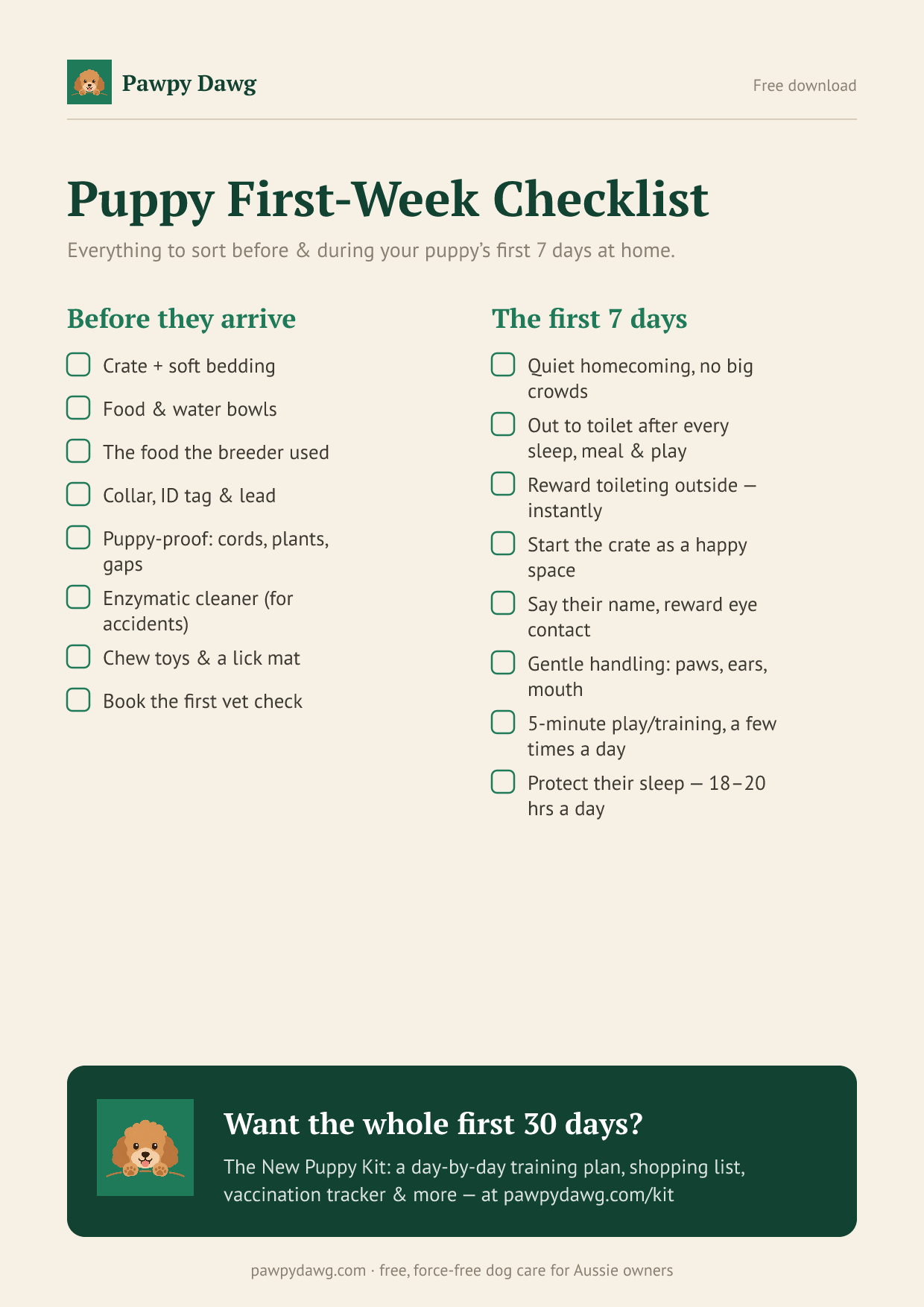
Free printable
Free: the Puppy First-Week Checklist
Everything to sort before and during your puppy's first 7 days home — a printable one-pager. Plus the occasional genuinely useful dog tip. No spam, unsubscribe anytime.
Related guides

Is Pet Insurance Worth It in Australia? The Honest Maths
Is pet insurance worth it in Australia? We crunch real premiums vs real vet bills — cruciate surgery, snake bite & more — so you can decide with confidence.
Read the guide →
How Much a Dog Really Costs Per Year in Australia (2026 Breakdown)
How much does a dog cost per year in Australia? 2026 line-item breakdown covering food, vet, insurance, grooming & the costs first-timers always miss.
Read the guide →
Dog Vaccination Schedule in Australia: What, When and What It Costs
Confused by C3, C5 and kennel cough? Here's your complete dog vaccination schedule Australia cost guide — puppy timelines, adult boosters & typical AUD prices.
Read the guide →