
Teaching a Dog to Settle: The Calm-on-a-Mat Method
Learn how to teach your dog to settle on a mat at cafes, with visitors, or at home — a simple 5-step plan with realistic week-by-week progress and common setbacks fixed.

Written by Bradley Brown
Founder & editor · Reviewed 2026-11-10
If You Only Do Five Things, Do These
- Choose one mat and keep it consistent — the same mat goes everywhere until the behaviour is solid.
- Mark and reward the moment all four paws are on the mat — don't wait for a perfect down straight away.
- Build duration in tiny steps — start at five seconds, not five minutes.
- Release your dog deliberately — a clear release word tells them when calm is "done," which makes it meaningful.
- Take the mat to one new place per week — generalisation is the whole game.
That's the core of the calm-on-a-mat method. Everything below unpacks the why behind each step and shows you how to rescue it when things go sideways.
Pick Your Mat and Make It Mean Something
The mat is not just a prop — it becomes a conditioned cue in its own right. Over time your dog learns that the sight and feel of that surface predicts good things and signals "this is your job right now." That's why consistency in the early weeks matters: switching between three different mats before the behaviour is established dilutes the association.
What works well: A flat rubber-backed bath mat, a small folded blanket, or a purpose-made dog mat roughly big enough for your dog to lie on with their elbows touching it. Avoid anything too bulky to fold into a bag — portability is the whole point once you move to cafes.
The most common mistake here: Owners place the mat in one corner of the living room and never move it, then wonder why the dog won't use it at the coffee shop. The mat needs to become a portable "calm zone," not a piece of furniture.
To start building the association, simply drop a treat onto the mat every time you walk past it for the first day or two. No commands, no fuss. You're teaching the dog that the mat is a reliably good place to be before you ask anything of it.
Mark and Reward Contact — Don't Rush the Down
New trainers almost always skip ahead to asking for a down the moment the dog steps on the mat. This creates a dog who performs a reluctant drop and immediately pops back up, because the duration and the position were never actually trained — they were assumed.
Instead, use a marker (a clicker, or the word "yes") and reward any voluntary paw contact with the mat. Here's the rough progression:
- Two paws on mat → mark and treat (day one to two)
- Four paws on mat → mark and treat (day two to three)
- Dog begins to offer a sit or down → jackpot a few treats in a row (day three to five)
You're not luring a down. You're waiting for the dog to offer it because standing on the mat has stopped producing rewards. Most dogs get there within three to five short sessions of two to three minutes each. If yours doesn't, try feeding the treat low to the ground so they naturally lower their head, which often tips them into a down.
Duration comes next. Once the dog is reliably lying down on the mat, start stretching the gap between the down and the treat: five seconds, then ten, then twenty. If the dog gets up before you mark, simply reset calmly — no scolding, just a neutral "back to your mat" and start the timer again. Frustration at this stage is the number-one reason progress stalls.
The Release Word: Why "Stay" Is the Wrong Tool Here
Most people say "stay" and then call their dog off the mat when they're done. The problem is "stay" tells the dog nothing about when it ends, which creates anxiety and constant checking-in with you.
A release word — "free," "okay," or "off you go" — does the opposite. It clearly marks the end of the behaviour, which paradoxically makes the dog more confident to hold the mat because they know exactly when they're allowed to leave.
Teach it this way: dog is on mat in a down, you say your release word in a cheerful tone and toss a treat off the mat. The dog gets up to get it. That's the full rep. After a few repetitions the dog understands that the release word, not their own restlessness, ends the job.
Once you have a release word working, drop "stay" entirely for this exercise. The mat behaviour is an enduring behaviour by definition — the dog holds position until released. You don't need a separate stay cue layered on top.
Adding Distractions Without Losing the Plot
This is where most people teach dog to settle in theory but not in real life. The dog is perfect at home, disastrous at a cafe. That gap exists because distractions were added too fast and duration was added at the same time.
The rule: when you raise one criterion, lower the other. New location? Drop duration back to five seconds. New distraction (a visitor, a skateboard rolling past)? Same thing — shorten the ask.
A practical progression:
- Week 1–2: Mat in the lounge room, no distractions, building to two to three minutes of settled behaviour.
- Week 3: Mat in a different room, back yard, or front porch. Duration drops to thirty seconds and rebuilds.
- Week 4: Mat in one genuinely new location — a friend's house, a quiet outdoor café table on a weekday morning. Keep sessions under five minutes. Leave before the dog loses it.
- Week 5 onwards: Gradually increase the busyness of the environments.
Visitor prep specifically: Before guests arrive, tire the dog slightly with a short walk or a game of fetch, then settle them on the mat before you open the door. Ask the visitor not to greet the dog until you release them from the mat. This one step removes most of the chaos people associate with dogs and visitors.
Fixing the Most Common Setbacks
The dog keeps getting up. You've pushed duration too fast. Go back to a duration the dog can hold reliably — even if that's ten seconds — and rebuild from there. This is not failure; it's just calibration.
The dog won't go to the mat in a new place. The mat association isn't strong enough yet. Spend another week in controlled home environments with higher-value treats (small pieces of cooked chicken or cheese rather than dry kibble) before the next location jump.
The dog lies down but is clearly stressed — panting, lip-licking, scanning. The environment is too distracting for where you are in training. Move to a quieter spot and let the dog decompress before asking again. A dog who is over threshold cannot learn.
The dog is brilliant at home but loses the plot completely at the café. This is a generalisation problem, not a defiance problem. Your dog isn't being stubborn — they genuinely haven't connected "mat at home" with "mat at this noisy place." You need more intermediate steps: backyard, friend's quiet garden, then café at 7am before the crowd, then café at a normal time.
What to Expect, Week by Week
Week 1: The dog starts moving voluntarily to the mat and offering a down. Sessions feel messy. That's normal — you're building a new habit from scratch.
Week 2: Duration reaches one to two minutes in a low-distraction environment. The dog begins to look relaxed (head lowered, soft eyes, slow breathing) rather than merely compliant.
Week 3: You can move the mat to a second familiar location and the behaviour holds reasonably well. The release word is reliable.
Week 4: A short, successful outing to one real-world location — a café, a friend's place, the vet waiting room — with the mat producing noticeably calmer behaviour than you'd get without it.
Week 6–8: The mat is a genuinely portable tool. Your dog settles for twenty to thirty minutes while you have a coffee or host guests, with only occasional check-in treats to maintain the behaviour.
Five to ten minutes of practice a day gets most dogs to that point. You haven't ruined anything, and you don't need to overhaul your life. You just need a mat, a marker, and a little patience with the timeline.
Frequently asked questions
How long does it take to teach a dog to settle on a mat?
Most dogs show reliable mat behaviour in a familiar environment within one to two weeks of daily five-to-ten-minute sessions. Generalising that behaviour to cafes and visitors typically takes four to eight weeks total, depending on the dog's age, temperament, and how consistently you practise.
What age can I start mat training my dog?
You can start as early as eight weeks old using very short sessions of one to two minutes. Puppies tire quickly but learn associations fast. Older dogs can absolutely learn mat training too — the timeline may be slightly longer, but there is no age at which a dog cannot benefit from this kind of structured calm.
Can I use any mat or blanket, or does it need to be something specific?
Any flat, portable surface works as long as it's consistent in the early stages. A rubber-backed bath mat or a folded blanket are ideal because they're easy to carry to cafes or a friend's house. Avoid swapping between multiple mats until the behaviour is well established, as the mat itself becomes part of the cue.
My dog gets up the second I stop looking at them. What am I doing wrong?
This usually means duration was increased too quickly, or the dog has learned that the behaviour only counts when you're watching. Shorten your duration back to what the dog can hold reliably, and practise occasionally turning your back or moving a step away before marking and rewarding. Build the expectation gradually that the mat behaviour holds regardless of where you are.
Do I need to keep rewarding my dog on the mat forever?
In the early learning phase, yes — regular treats maintain the behaviour. Once the dog is settled reliably across different environments, you can shift to a variable reward schedule (treating every few minutes rather than constantly) and eventually the mat becomes its own cue to relax. Many owners find a small treat every ten to fifteen minutes is enough to maintain a solid settle during a café visit.
Is the calm-on-a-mat method suitable for anxious or reactive dogs?
Yes, and it can be particularly helpful for them, but progress should be slower and environments chosen more carefully. Keep early sessions in very low-stimulation settings and avoid exposing a reactive dog to their triggers while they're still learning the mat behaviour. If your dog's anxiety is significant, working alongside a qualified veterinary behaviourist or certified trainer is worthwhile — costs in Australia typically range from around $100 to $250 AUD per session.
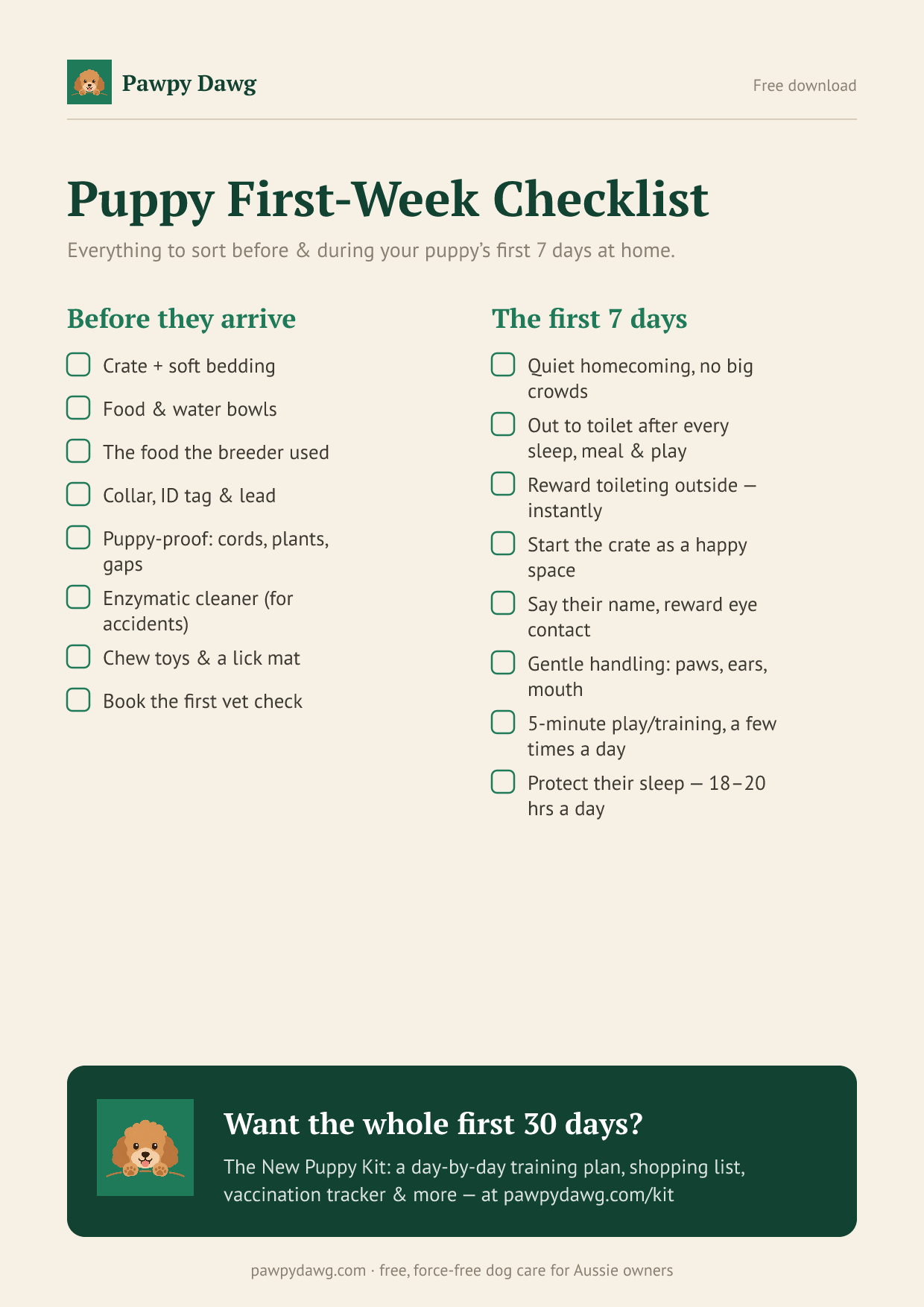
Free printable
Free: the Puppy First-Week Checklist
Everything to sort before and during your puppy's first 7 days home — a printable one-pager. Plus the occasional genuinely useful dog tip. No spam, unsubscribe anytime.
Related guides

Is Pet Insurance Worth It in Australia? The Honest Maths
Is pet insurance worth it in Australia? We crunch real premiums vs real vet bills — cruciate surgery, snake bite & more — so you can decide with confidence.
Read the guide →
How Much a Dog Really Costs Per Year in Australia (2026 Breakdown)
How much does a dog cost per year in Australia? 2026 line-item breakdown covering food, vet, insurance, grooming & the costs first-timers always miss.
Read the guide →
Dog Vaccination Schedule in Australia: What, When and What It Costs
Confused by C3, C5 and kennel cough? Here's your complete dog vaccination schedule Australia cost guide — puppy timelines, adult boosters & typical AUD prices.
Read the guide →