
The Puppy Socialisation Checklist: What to Do Before 16 Weeks
Use this puppy socialisation checklist to safely expose your pup to people, places & sounds before 16 weeks — without waiting for vaccinations to finish.

Written by Bradley Brown
Founder & editor · Reviewed 2026-11-10

The single most damaging piece of advice still doing the rounds at vet clinics and pet shops across Australia is this: "Keep your puppy home until they're fully vaccinated."
It sounds responsible. It is not. Puppies who miss the critical socialisation window because they were kept isolated for safety often end up fearful, reactive, or anxious — problems that are far harder to fix than parvovirus is to prevent. The American Veterinary Society of Animal Behavior, the Australian Veterinary Association, and virtually every modern behaviourist agree: the risk of a behavioural problem from under-socialisation is statistically greater than the risk of disease in a low-risk environment.
That doesn't mean taking your eight-week-old to an off-leash dog park. It means being smart about where you go and what you expose your puppy to, while the window is still open.
"Wait until all vaccinations are done before taking your puppy anywhere"
The socialisation window closes around 12–16 weeks. Full vaccination typically isn't complete until 16–18 weeks. If you wait for the all-clear, you've already missed most — or all — of the window.
During this period, the puppy brain is primed to accept new experiences as normal rather than threatening. After 16 weeks, the brain shifts into a more cautious mode and new things are assessed as potentially dangerous by default. That's not trainable away easily. Fear that sets in after the window closes can take months or years to manage.
What to do instead: Socialise before vaccinations are complete, but choose low-risk environments. Avoid places where unvaccinated or unknown dogs congregate — dog parks, pet shops, creek paths where dogs toilet. Safe options include:
- The homes of fully vaccinated, healthy dogs
- Puppy preschool classes (reputable ones require vaccination records for all attendees and use clean indoor surfaces — the risk is very low and the benefit is high)
- Being carried or placed in a pram/trolley in busy areas like hardware stores or outdoor cafés
- Front yard, driveway, or balcony experiences where unknown dogs don't have access
"Socialisation means playing with as many dogs as possible"
Dog-to-dog play is one tiny slice of socialisation. Owners who laser-focus on it often produce dogs that are brilliant with other dogs but fall apart around strangers, children, loud noises, or anything unfamiliar — because those things were never on the checklist.
A proper puppy socialisation checklist is wide. Think of it as everything your adult dog will encounter in their life introduced gently before the window closes.
People to meet (aim for variety, not just numbers):
- Men with beards, hats, or uniforms
- Children of different ages (always supervised, always calm)
- People using walking frames, wheelchairs, or crutches
- People wearing hi-vis, helmets, or sunglasses
- Delivery drivers, tradies, visitors arriving at the door
Sounds to introduce (low volume first, then gradually louder):
- Thunder, fireworks, and rain (use a sound desensitisation playlist — many are free on YouTube)
- Lawnmowers, vacuum cleaners, and power tools
- Traffic, motorbikes, and reversing trucks
- The vet clinic — pop in just to get weighed and get a treat, no procedure needed
Surfaces and environments:
- Grass, gravel, tiles, timber decking, carpet, wet surfaces
- Stairs, ramps, uneven ground
- Being in a car, in a crate, in a bag or carrier
The goal isn't a tick-box exercise done in one weekend. Spread experiences across weeks 8–16, keeping each session to 5–10 minutes. One new thing done well is worth ten things done badly.
"If your puppy seems scared, push through — they need to get used to it"
This is called flooding, and it reliably makes fear worse. When a puppy is overwhelmed — cowering, refusing to move, yawning constantly, tucking their tail, trying to hide — their stress hormones spike and the brain encodes that experience as dangerous. You are not building resilience. You are building a trauma memory.
The goal of socialisation is not mere exposure. It's positive association. The puppy needs to feel okay — ideally happy — during and after each new experience.
Signs you're overdoing it:
- Persistent yawning or lip-licking outside of tiredness/hunger
- Refusing food (a relaxed, curious puppy almost always takes treats)
- Inability to settle after you get home
- Hiding, clinging, or refusing to walk
- Sleeping excessively the following day
If you see these signs, the session was too long, too loud, or too much. Dial back. Move further away from the trigger. Use high-value treats (small pieces of cooked chicken or cheese work well). Let the puppy set the pace.
"Puppy preschool is optional — YouTube videos will do the same thing"
Online resources are genuinely useful for training mechanics, but they cannot replicate real-world exposure. The socialisation window requires actual novel experiences, not video footage of them. A puppy watching a video of children playing does not generalise to real children.
Puppy preschool — specifically one run by a qualified trainer using reward-based methods — does several things at once: controlled exposure to other puppies (of similar size and vaccination status), handling practice, early foundation skills, and owner education. For most Australian suburbs, a 4–6 week course runs between $150–$300 AUD and is one of the highest-return investments you'll make in your dog's life.
Look for trainers affiliated with the Pet Professional Guild Australia or the Delta Society (now PPG Australia), or who list positive reinforcement as their primary method.
A rough week-by-week guide for weeks 8–16
Weeks 8–10: Focus on the home and immediate surroundings. Introduce household sounds, handling (ears, paws, mouth), crate or pen, car rides, and one or two calm visitors per week. Keep it very low-key.
Weeks 10–12: Expand to safe outside environments. Begin puppy preschool if available. Introduce new surfaces, brief outings to quiet outdoor areas (held or carried), and calm children.
Weeks 12–14: Busier environments, louder sounds at a distance, more varied people. Short on-lead walks on quiet streets if the vet confirms it's appropriate for your area's disease risk.
Weeks 14–16: Continue building on what's already positive. If anything triggered mild fear earlier, revisit it from a greater distance with better treats. Don't rush new experiences — consolidate what you have.
You will not get through everything. That is fine. A puppy who has had 50 genuinely positive experiences is in far better shape than one who has had 100 rushed or stressful ones. Quality over quantity, every time.
As an Amazon Associate we earn from qualifying purchases.
Frequently asked questions
Can I take my puppy out before their second vaccination?
Yes, with some care. Avoid high-traffic dog areas like dog parks or pet shops where unvaccinated dogs congregate. Safe options include visiting homes with vaccinated dogs, being carried in busy outdoor areas, and attending a reputable puppy preschool. The socialisation window is too important to waste while waiting for a second vaccination.
What age does the puppy socialisation window close?
The primary socialisation window is generally considered to close around 12–16 weeks of age. After this point, the brain becomes more cautious about new stimuli, making positive associations harder to form. This is why early, positive exposure before 16 weeks is so strongly recommended by veterinary behaviourists.
How do I socialise a puppy to loud noises like thunderstorms and fireworks?
Start with a free sound desensitisation playlist (search YouTube for 'puppy sound socialisation') played at very low volume while your puppy eats or plays. Gradually increase the volume over days or weeks, always pairing the sound with something positive. Never force the puppy to stay near a sound that frightens them — distance and low intensity are your tools.
My puppy is already 14 weeks and hasn't been socialised much. Is it too late?
It's not too late, but act now — you still have a couple of weeks in the window, and early adolescence (up to about 6 months) still offers meaningful learning opportunities. Focus on the most important things first: calm people, real-world sounds, and positive handling. Work with a reward-based trainer if fear responses are already showing.
How long should a socialisation session be for a young puppy?
Five to ten minutes is plenty for puppies under 12 weeks. Young puppies tire and overstimulate quickly, and an overwhelmed puppy is not absorbing positive experiences. One short, calm outing per day is more effective than a long outing that pushes the puppy past their comfort zone.
Is puppy preschool safe before vaccinations are complete?
Reputable puppy preschool classes manage disease risk by requiring up-to-date vaccination records for all attendees and using clean, indoor surfaces. The Australian Veterinary Association supports attendance from 7–8 days after the first vaccination. The behavioural benefits of early socialisation in a controlled class environment outweigh the low risk of disease exposure.
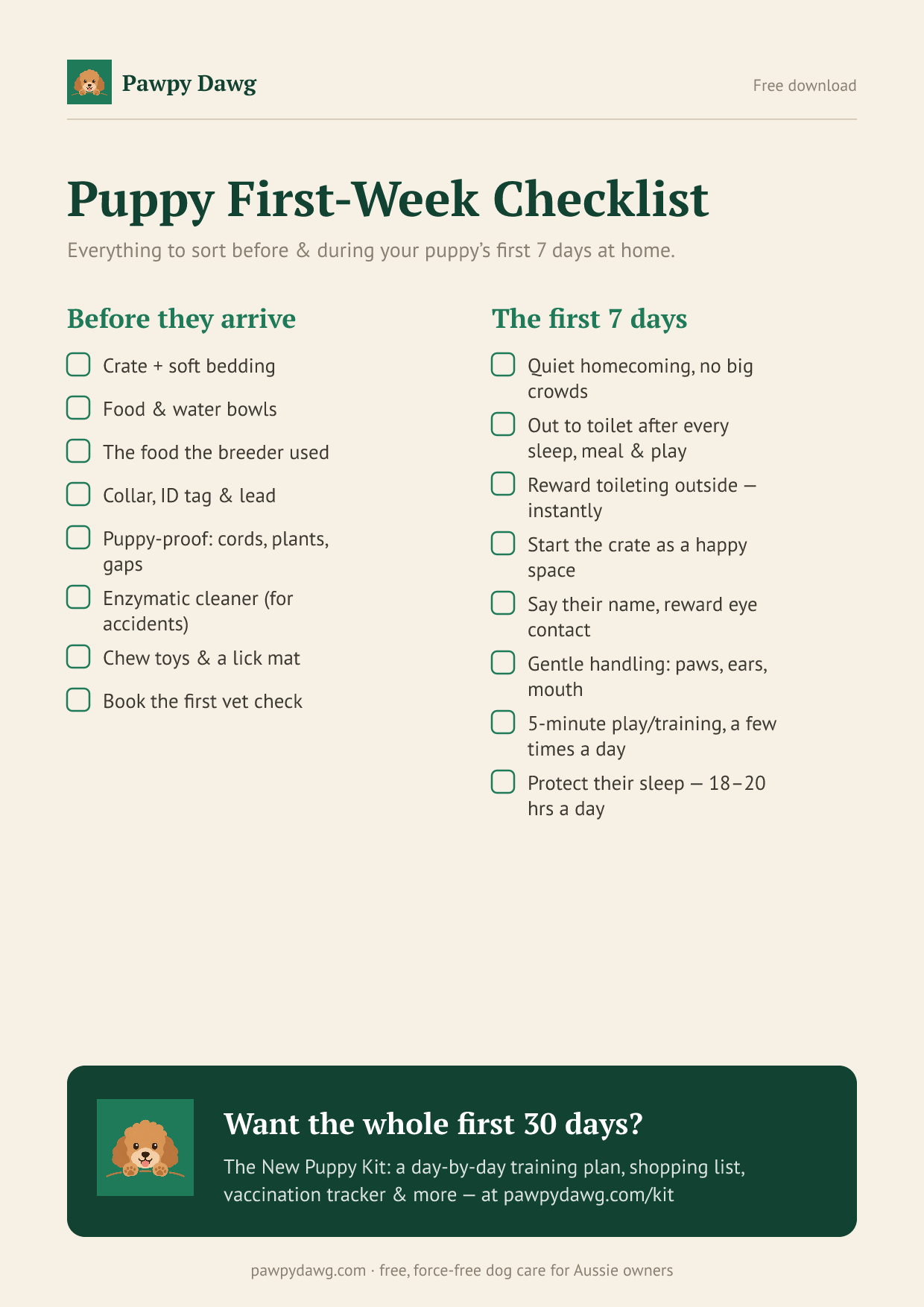
Free printable
Free: the Puppy First-Week Checklist
Everything to sort before and during your puppy's first 7 days home — a printable one-pager. Plus the occasional genuinely useful dog tip. No spam, unsubscribe anytime.
Related guides

Is Pet Insurance Worth It in Australia? The Honest Maths
Is pet insurance worth it in Australia? We crunch real premiums vs real vet bills — cruciate surgery, snake bite & more — so you can decide with confidence.
Read the guide →
How Much a Dog Really Costs Per Year in Australia (2026 Breakdown)
How much does a dog cost per year in Australia? 2026 line-item breakdown covering food, vet, insurance, grooming & the costs first-timers always miss.
Read the guide →
Dog Vaccination Schedule in Australia: What, When and What It Costs
Confused by C3, C5 and kennel cough? Here's your complete dog vaccination schedule Australia cost guide — puppy timelines, adult boosters & typical AUD prices.
Read the guide →